Coverage status: Listed market — confirm community

Service availability in Denver is confirmed for each participating community before activation.

Residents can choose and pay for optional pickup before move-out. Communities pay $0 to offer that program; property-requested removals are separately approved, priced and paid.

Denver, Colorado

Apartment Move-Out Disposal in Denver

One move-out disposal program for apartment, build-to-rent and professionally managed rental portfolios across Metro Denver and Colorado’s Front Range.

ReadyOut gives rental-housing operators one system for the furniture, mattresses, bulk items and move-out debris residents leave behind. Residents can arrange and pay for removal before move-out. When items are still left behind after possession, the community can order a trash-out through the same program.

One catalog. One operating process. ReadyOut service, from pickup to documentation. Portfolio-level visibility.

Communities pay $0 to offer the optional resident program. Residents choose, book and pay. Eligible resident-paid pickups may generate revenue share up to 15%, where permitted under agreed terms. Property removals are separately approved, priced and paid.

Service availability and pickup options are confirmed for each participating community and booking.

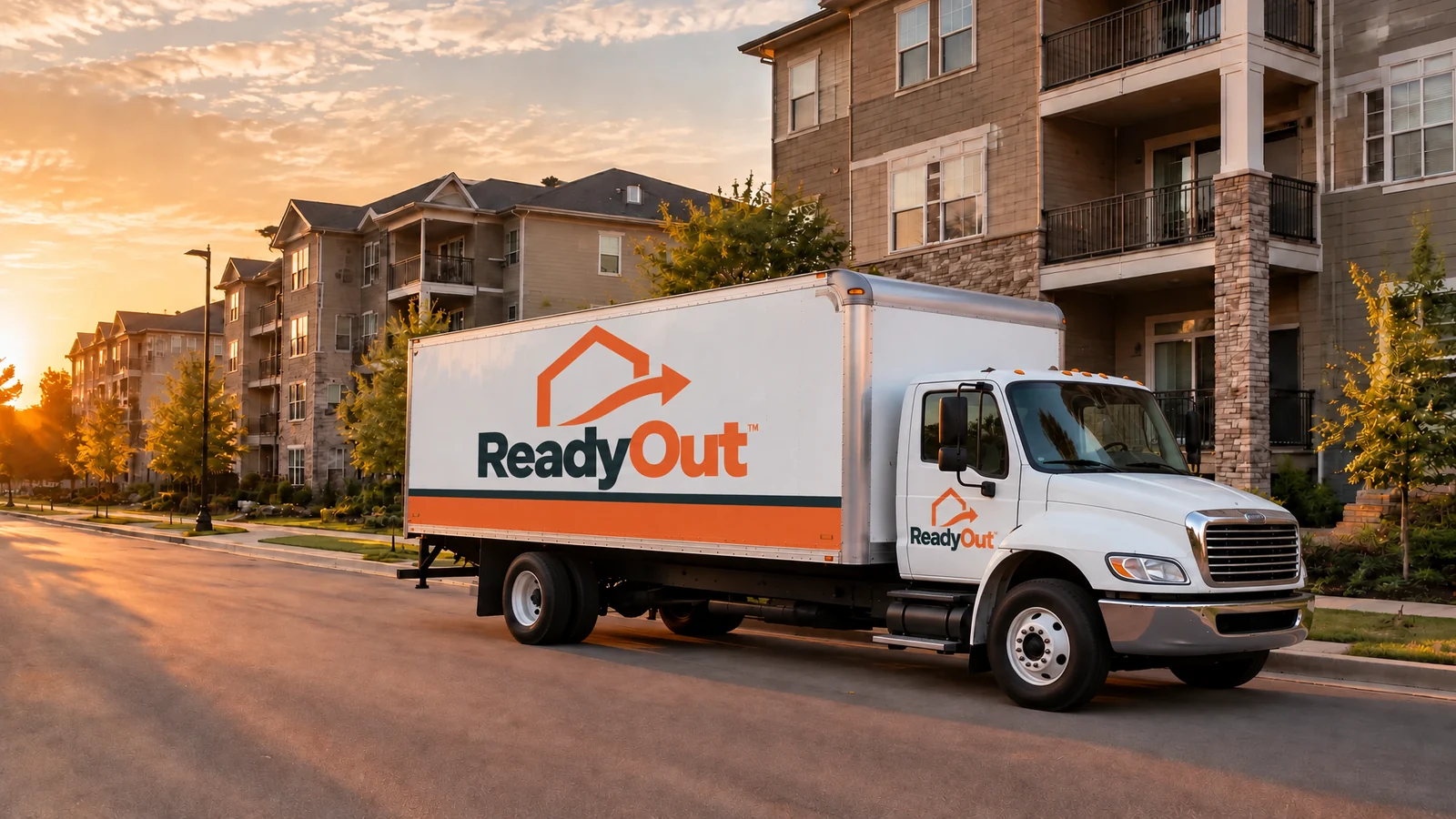
Wide shot of ReadyOut-branded white box truck on residential street with apartment buildings, golden-hour natural daylight.
Metro Denver multifamily

Move-out disposal built for the Front Range’s apartment communities.

Denver is one of the largest professionally managed apartment markets in the western United States.

The market also has a substantial professionally managed rental-home footprint.

3,041

Units added in the first four months of 2026

Apartments. Build-to-rent communities. Professionally managed rental homes.

Different building types. The same recurring move-out problem. What happens to everything residents leave behind? ReadyOut gives operators one answer.

Before possession

Solve the disposal problem before move-out.

Residents usually know before move-out which furniture they are not taking. They knew the sectional was not coming. They knew the mattress needed to go. They knew the dining table would not fit in the next apartment. They knew there were household items they did not want to move.

But disposal often gets pushed to the final days. Then the resident improvises.

ReadyOut moves that decision earlier.

  1. They try to sell it.
  2. Give it away.
  3. Find someone with a truck.
  4. Put it beside the dumpster.
  5. Move it into the garage.
  6. Or surrender possession with the items still inside.
The operating model

The resident program first. Supporting removal when needed.

Before move out

Resident move-out pickup

Participating communities can give residents access to a simple removal menu during the move-out process. Residents select what needs to be removed, schedule service and pay for the pickup.

ReadyOut sets the resident price. Participating communities can receive eligible revenue share on eligible resident-paid orders, where permitted.

Instead of waiting to discover what was left behind, the community gives residents a disposal option while they can still solve the problem.

Remove the item before the community inherits it.

After move out

Support for the removal work that remains

Resident-paid removal will not prevent every trash-out. When possession is returned and contents remain, the community can request a separately approved, priced and paid ReadyOut trash-out. Ordering opens only after onboarding.

  • Sofas and sectionals
  • Mattresses and box springs
  • Dressers
  • Tables and chairs
  • Televisions
  • Small appliances
  • Boxes
  • Bagged household contents
  • Patio furniture
  • Garage contents
  • General move-out debris
  • Partial apartment contents
  • Full trash-outs

Service availability and pickup options are confirmed for each participating community and booking.

Before-and-after documentation gives the community a record of what was present and what was removed.

Get the unit empty so the turn can continue.

Local waste systems

Large Denver apartment communities operate outside the city’s residential waste system.

Denver makes a clear distinction between smaller residential properties and larger apartment communities. The City and County of Denver provides municipal trash and recycling collection to single-family homes and apartment or townhome properties containing seven units or fewer. Apartment buildings and townhome communities containing eight or more units generally rely on private waste companies instead.

That matters for professional apartment operators. A resident living in a single-family home may have access to city collection and residential large-item services. A 300-unit apartment community is operating in a commercial waste environment.

The community already has to manage:

  • Private hauling contracts.
  • Dumpster or compactor capacity.
  • Recycling.
  • Vendor access.
  • Collection schedules.

Move-out furniture creates another waste stream on top of that system.

ReadyOut is designed specifically for that operating environment.

Hidden expense

A dumpster is not a move-out disposal program.

Routine apartment waste and move-out waste behave differently.

Everyday household garbage enters the waste system gradually. Move-out debris can arrive all at once: a sectional, two mattresses, a bedroom set, patio furniture, boxes, twenty bags of household contents, an entire apartment with items left behind.

Several residents moving during the same weekend can overwhelm an enclosure quickly. Then maintenance moves furniture, photos get taken, a vendor gets called, a quote gets requested, someone approves the work, and the furniture may be handled several times before it finally leaves the community.

Routine community waste stays with the community’s normal waste program.

Move-out furniture and items left in the apartment get their own operating process.

Credentialing

Vendor credentialing matters.

Denver requires businesses hauling waste within the city to operate under the city’s solid-waste service licensing framework. The licensing process requires information about vehicles, insurance, waste types and the collection methods used by the waste service.

That matters for professional community portfolios. The person who can remove a couch cheaply is not automatically the same thing as a scalable portfolio solution. A national or regional operator needs more than someone with a truck.

It needs:

  • Appropriate credentials.
  • Insurance.
  • Consistent pricing.
  • Defined service standards.
  • Reliable completion.
  • Job documentation.
  • Operational accountability.

ReadyOut is designed around that standard.

Operating cost

The trash-out invoice is not the total cost.

Accounts payable can see what the hauling vendor charged. It cannot necessarily see everything that happened before the invoice arrived.

  • Who discovered the furniture?
  • Who photographed it?
  • Who contacted the vendor?
  • Who waited for pricing?
  • Who approved the job?
  • Did maintenance move anything?
  • Was the furniture staged beside the dumpster first?
  • Did the turn crew have to wait?
  • Was an additional waste pickup required?
  • Did someone document everything for a resident charge?

Every step consumes labor or operating capacity. At one community, that work can seem insignificant.

Across a portfolio of communities and every move-out, it adds up. ReadyOut turns move-out disposal into a defined operating function.

Read The Trash Out Invoice Is Not the Cost of the Trash Out and Why Is Your Maintenance Team Moving Couches?

Front Range footprint

One Denver program across the Front Range.

Subject to community-level confirmation, ReadyOut reviews rental portfolios throughout Metro Denver and the broader Front Range, including:

  • Denver
  • Aurora
  • Lakewood
  • Arvada
  • Westminster
  • Thornton
  • Centennial
  • Englewood
  • Littleton
  • Broomfield
  • Northglenn
  • Parker
  • Castle Rock
  • Boulder
  • Longmont
  • Fort Collins
  • Greeley
  • and surrounding Colorado communities

The Denver metro spans many cities across the Front Range, illustrating how quickly a regional portfolio can spread across different municipalities and local operating environments.

Instead of every community finding its own removal solution, ReadyOut gives operators a common catalog, ordering workflow and service standard.

One portfolio program. ReadyOut handles the service.

Who it is for

Built for large multifamily portfolios.

Community Management Companies

Create one move-out disposal program across multiple Denver-area communities.

Regional Operations Teams

Give onsite teams a clear process instead of asking each community manager to solve resident-left furniture alone.

Procurement Teams

Use one service process, reduce pricing variation and understand what communities are actually purchasing.

Asset Management Teams

Identify where move-out disposal expenses occur and where operating costs may currently be hidden inside maintenance and community-level activity.

Community Teams

Give the community team one place to send both resident-paid removal requests and community-ordered trash-outs.

Market growth

Denver has added apartments at significant scale.

Denver has spent several years absorbing substantial new apartment supply. Developers added 3,041 units during the first four months of 2026, while another 19,042 apartments remained under construction at that point. Stabilized occupancy stood at 93.2% in March.

By September 2026, Yardi reported that approximately 18,000 units were still under construction across the metro.

Denver was also one of the country’s most active construction markets during the recent development cycle. Yardi recorded 10,953 apartment construction starts during 2025, even after starts had declined substantially from their 2022 peak.

For ReadyOut, the important point is the operating base. A large base of professionally managed apartments already exists across the market. Every occupied unit eventually moves through the same cycle.

  1. 1Lease.
  2. 2Occupancy.
  3. 3Notice to vacate.
  4. 4Move-out.
  5. 5Turn.
  6. 6New resident.

At that scale, move-out disposal is not an occasional bulky items-removal problem.

It is an operating category.

SFR secondary

Denver’s rental market extends beyond apartments.

Denver also has professionally managed rental homes and build-to-rent communities. Professionally managed rental homes create the same basic move-out problem as apartments. Residents leave furniture, mattresses, garage contents, patio furniture, boxes, household goods and large bulky items.

The type of home changes. The operating problem does not.

ReadyOut can extend the same operating model across professionally managed rental-home portfolios: resident-paid removal before move-out. Community-ordered trash-out after possession.

  • Furniture.
  • Mattresses.
  • Garage contents.
  • Patio furniture.
  • Boxes.
  • Household goods.
  • Large bulky items.
BTR secondary

ReadyOut for Denver build-to-rent communities.

Build-to-rent communities combine professional community management with the physical layout of single-family housing. A BTR community may contain dozens or hundreds of professionally managed rental homes.

Residents move. Furniture gets left behind. Garages need to be cleared. Patio furniture remains. Homes need to turn. Without a consistent process, each event can turn into another one-off hauling decision.

ReadyOut gives the operator one move-out disposal workflow across the community.

Resident-paid removal before move-out. Community-ordered trash-out after possession.

Waste diversion

Denver is increasingly focused on waste diversion.

Denver’s broader waste strategy increasingly separates materials rather than treating everything as one garbage stream. Move-out units can contain:

  • Cardboard.
  • Furniture.
  • Textiles.
  • Electronics.
  • Metal.
  • Mattresses.
  • Reusable household goods.
  • General trash.

Instead of viewing an apartment with items left behind as one pile of bulky items, a managed disposal program can create better visibility into what is actually leaving the community and how it is handled.

ReadyOut creates an operating layer around that move-out waste stream.

Colorado weather

Weather can make move-out waste more operationally difficult.

Denver also has a factor that Sun Belt markets do not experience in the same way: weather. Furniture staged outdoors during snow, freezing temperatures or heavy weather can quickly become a bigger operational issue.

Mattresses become wet. Furniture becomes damaged. Items can interfere with snow removal. Outdoor staging areas become less usable. A pile that might sit temporarily beside an enclosure in another market can become a community-management problem quickly in Colorado.

The cleaner approach is to coordinate removal rather than create an outdoor holding area.

ReadyOut gives onsite teams a defined path from unit to removal.

Resident experience

Put disposal into the resident move-out journey.

The best time to solve a resident-left furniture problem is while the resident still controls the item.

Instead of only telling residents what they cannot leave behind, give them something they can do.

  1. Select the item.
  2. See the price.
  3. Schedule the pickup.
  4. Remove it before move-out.

That changes the disposal conversation.

  • Notice-to-vacate acknowledgments
  • Move-out checklists
  • Resident portals
  • Move-out reminder emails
  • Final inspection instructions
  • Community office materials
  • QR codes
  • Community management communications
Procurement

One catalog instead of repeated quotes.

  1. 01The onsite team discovers the items.
  2. 02Someone takes photos.
  3. 03A vendor is contacted.
  4. 04The vendor asks for more information.
  5. 05A quote comes back.
  6. 06Someone approves it.
  7. 07The vendor schedules service.
  8. 08The unit gets cleared.
  9. 09The invoice arrives.
  10. 10Then the entire process begins again with the next move-out.

Without a consistent program, every trash-out can become its own purchasing event. ReadyOut replaces that repeated cycle with a defined service catalog.

Common jobs can be priced in advance. Community teams know how to order. ReadyOut handles execution to a defined standard. Operators can see activity across the portfolio.

That creates a fundamentally different operating model.

Apartments, self-storage, single-family and commercial in Denver

ReadyOut supports more than apartment communities in Denver. Whatever you manage, your team snaps photos, sees the price and requests the removal in under a minute. Every client is onboarded first, and service is confirmed for each property before the first order.

Apartment communities

Residents book and pay for their own pickup before move-out. When items are left behind, your team orders the removal.

Multifamily

Self-storage

Customers arrange pickup of their own items. Facility teams order removal for units they are authorized to clear.

Self-storage

Single-family rentals

One ordering process across scattered addresses, with completion documented for every home.

Single-family rentals

Commercial property

When tenants or occupants leave furniture and bulky items behind, your team orders the removal.

Commercial property
Common questions

Denver move-out disposal questions

Does ReadyOut provide apartment cleanouts in Denver?

ReadyOut manages move-out furniture removal and post-move-out trash-outs for participating apartment communities and rental portfolios throughout Metro Denver and the broader Front Range.

Can residents schedule furniture removal before moving?

Yes. Participating communities can give residents access to a pickup menu during the move-out process so resident-left furniture and household items can be removed before possession is returned.

Does Denver provide city trash service to large apartment communities?

Generally, no. Denver’s municipal collection system serves single-family homes and apartment or townhome properties containing seven units or fewer. Larger apartment communities generally use private waste companies.

Does ReadyOut replace our regular waste service?

No. ReadyOut focuses on move-out furniture, mattresses, household items and items left in the apartment. The community’s normal dumpster, compactor and recurring commercial waste services can remain in place.

Can ReadyOut clear an entire apartment?

Yes. Communities can order individual-item removal, partial trash-outs or larger complete trash-outs depending on what remains.

Does ReadyOut work with build-to-rent communities?

Yes. Denver has a meaningful professionally managed SFR/BTR market, and ReadyOut can support those communities as well as traditional multifamily.

Can one program cover Denver, Aurora, Boulder and Front Range properties?

Yes. ReadyOut is designed to establish one service catalog and operating standard across participating communities while ReadyOut handles service across participating communities.

How fast can a trash-out be completed?

Service availability and pickup options are confirmed for each participating community and booking.

Denver Portfolio Impact Analysis

See what move-out disposal is actually costing your Denver portfolio.

Your accounting system can tell you how much individual hauling vendors invoiced. That does not necessarily tell you what the organization spends managing move-out disposal.

ReadyOut’s Portfolio Impact Analysis can help identify:

  • Current move-out removal and trash-out spend
  • Pricing differences between communities
  • Communities generating the most disposal volume
  • Repeat furniture and mattress-removal patterns
  • Vendor fragmentation
  • Potential resident-paid removal opportunities
  • Where pricing can be made consistent
  • Where onsite teams may be doing work that never appears on a hauling invoice

Request my portfolio impact analysis

Start with portfolio size, markets and estimated spend. If you have move-out removal, furniture-removal, move-out hauling or unit-clear invoices, you can share them privately to improve the analysis. We’ll organize the activity and show you where a consistent move-out disposal program may make sense.

Request my portfolio impact analysis

Have the data now? The Portfolio Impact Analysis form supports private PDF, CSV, XLS and XLSX uploads.